Whitefield Real Estate in 2026: The Complete Buyer's Guide
Price trends, the metro effect, micro-market comparison and rental yields — a data-led guide to buying property in Whitefield, Bengaluru in 2026.
Why Whitefield still leads East Bengaluru
Whitefield's advantage over every newer East Bengaluru corridor is not land or pricing. It is the twenty-year head start it has on social infrastructure. Sarjapur has better road width in places. Devanahalli has the airport. Hoskote Road has cheaper land. None of them have the combination Whitefield has assembled — a 1,600-bed teaching hospital, four or five schools that families actively relocate for, three full-scale malls, and an office base deep enough that a household can change employers three times without changing houses.
That base is what makes the micro-market resilient. Bengaluru has had two soft property cycles in the last decade, and in both of them Whitefield's correction was shallower and its recovery faster than the city average. The reason is structural: demand here is generated by employment within a five-kilometre radius, not by speculative buyers from elsewhere in the city.
The employment picture in 2026 is stronger, not weaker, than it was pre-pandemic. ITPL and the EPIP SEZ cluster continue to absorb space. Google's Alembic City campus — roughly thirty lakh square feet — anchors the Hope Farm end specifically. Brookefield and ECC Road hold a dense mid-size office belt. Return-to-office mandates across the large IT services firms have, if anything, tightened the link between where people work in Whitefield and where they want to live.
The price trend, honestly read
Whitefield apartment values have appreciated by roughly 80% over the last five years. That number gets quoted constantly, and it is broadly accurate, but it needs three qualifications before a buyer should act on it.
First, the base was low. The 2020–21 period was the softest Bengaluru residential market in a decade, and a large part of the 80% is recovery from a depressed base rather than pure real appreciation. Second, the gains are not evenly distributed. Premium and branded stock has run considerably harder than mid-segment inventory; a well-located branded tower has outperformed a nearby unbranded one by a wide margin. Third, construction cost inflation has absorbed a meaningful share of the headline appreciation, which is why developer margins have not expanded in proportion.
What that means practically: the rate you see today in Whitefield is not a bubble price, but it is also not an early-cycle price. Premium resale stock across the Whitefield belt currently transacts in a ₹17,000–20,000 per sq.ft. band depending on age, brand and metro proximity. New pre-launch inventory near Hope Farm Junction is entering at approximately ₹16,000 per sq.ft. — a discount to standing stock that reflects the four-to-five year construction horizon, and that historically narrows as a project moves from pre-launch through RERA registration to launch.
The metro effect on Hope Farm Junction
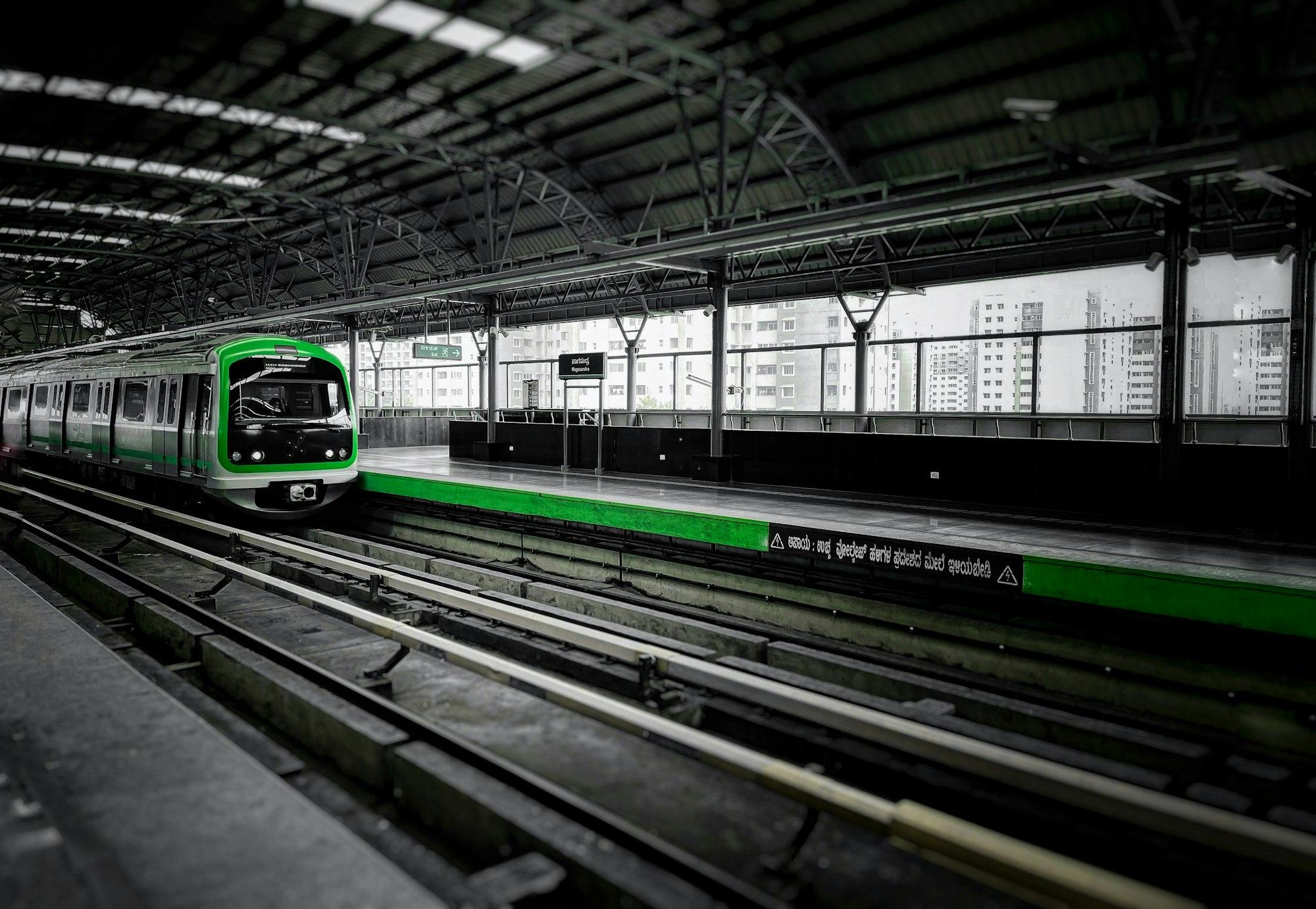
The Purple Line's extension into Whitefield, operational since March 2023, is the single largest structural change to this micro-market in a decade — and it is systematically under-weighted by buyers who have only ever evaluated Bengaluru property by road connectivity.
The distinction that matters is between a metro that is planned and a metro that is running. Bengaluru has a long history of sanctioned corridors slipping by five, seven, nine years, and the market has learned to discount them heavily. Hopefarm Channasandra and Kadugodi are not in that category. They are open, they run, and the pricing premium attached to walkable-to-station projects is already visible in transaction data rather than pending on a promise.
Walkability is the operative word. A station three kilometres away requires a car or an auto at both ends, which erases most of the time benefit. A station within a five-minute walk changes daily behaviour: it removes the second car from the household, it makes a Central Business District commute genuinely viable, and it materially widens the tenant pool at resale. In cities where metro networks have matured, walkable-to-station residential consistently outperforms drivable-to-station residential over a ten-year horizon. Bengaluru is early in that curve, which is where the opportunity sits.
Comparing the Whitefield micro-markets
"Whitefield" now covers a belt wide enough that the label alone tells a buyer very little. Four sub-markets behave quite differently.
- Old Whitefield / Whitefield Main Road: the most established, the most expensive, and the tightest on new supply. Best social infrastructure, worst peak-hour road congestion.
- Hope Farm Junction / Kadugodi: the current centre of gravity. Metro-served, adjacent to the Alembic City campus, and the one pocket still releasing meaningful new premium supply. Rates sit just below Old Whitefield with a stronger infrastructure trajectory.
- Varthur / Gunjur: more affordable, considerably more traffic-constrained, and dependent on road widening that has repeatedly slipped. Higher risk, higher potential upside.
- Whitefield–Hoskote Road: the frontier. Cheapest entry, thinnest social infrastructure, longest hold required.
For a buyer prioritising capital preservation with real appreciation potential, Hope Farm Junction is currently the most defensible of the four: it has the infrastructure of the mature pockets and the supply pipeline of the emerging ones.
Where the real supply gap is
Whitefield is not short of apartments. It is short of one specific product: the large, branded, low-density home.
Two and three BHK inventory in the 1,200–1,800 sq.ft. range is abundant, from a dozen developers, at every price point. But a senior technology professional, a founder, or a returning NRI looking for a 2,500–4,000 sq.ft. home from a listed developer in a low-density estate has a genuinely short list — often fewer than five live options across the entire belt at any moment.
This is why the segment behaves differently on the downside. Thin supply plus a buyer profile that is largely equity-funded rather than leverage-dependent means less forced selling in a soft cycle, and faster absorption in a recovering one. It is the structural argument for the large-format segment specifically, distinct from any argument about Whitefield generally.
Rental yields and the tenant pool
Whitefield rental yields sit at roughly 3–3.75%, against a Bengaluru average nearer 3%. Modest by global standards, but the composition of the tenant pool matters more than the headline number.
Tenants here are drawn from ITPL, the EPIP SEZ cluster, the Brookefield office belt and, increasingly, the Alembic City campus. That is a corporate, salaried, largely long-tenure pool, and it produces two things a landlord values more than an extra half point of yield: low vacancy and low churn. Large-format four and five bedroom homes rent to a narrower but considerably better-capitalised segment — senior expatriate postings, CXO relocations, and company-leased executive housing — where lease durations of two to three years are normal.
One caution: the yield on a ₹4 crore-plus home will typically be lower than on a ₹1.5 crore two-bedroom in the same locality. Large-format purchases are made for capital appreciation and for occupation, not for yield. A buyer whose primary objective is monthly rental income should be honest with themselves that this is not the product for it.
The risks nobody puts in a brochure
Three deserve explicit statement.
Traffic remains the structural constraint. The metro helps enormously for corridor-parallel trips, but Whitefield Main Road at peak hour is still Whitefield Main Road. Any buyer should drive the actual commute at 9 a.m. on a weekday before signing, not at 3 p.m. on a Sunday after a site visit.
Pre-launch carries real timing risk. Buying before RERA registration means buying before the approved plan, the committed handover date and the registered carpet areas are legally fixed. The upside is price; the downside is that specifications and timelines can move. No payment should ever be made against an unregistered project, and any advisor who suggests otherwise should be walked away from.
Concentration risk in the employment base. Whitefield's demand is tied to the technology sector. A prolonged sectoral contraction would be felt here before it is felt in a more employment-diversified part of the city. Diversification into GCCs, biotech and financial-services back offices has reduced this, but not eliminated it.
Verdict for a 2026 buyer
Whitefield in 2026 is a mid-cycle market, not an early one. The easy money — the 2021 entry — has been made. What remains is a market with an operational metro, a deepening office base, mature social infrastructure and a genuine, quantifiable shortage of large branded homes.
For an end-user buying a 2,500 sq.ft.-plus home near Hope Farm Junction with a five-to-ten year horizon, the case is straightforward and does not depend on aggressive appreciation assumptions. For a pure investor seeking a two-to-three year flip, the case is considerably weaker, and the pre-launch discount is compensation for a risk that a short holding period does not allow you to ride out.
Buy here for the address, the product and the horizon. Treat the appreciation as the bonus it historically has been, not the thesis.
Frequently asked questions
Is Whitefield a good place to buy property in 2026?
Yes, for buyers with a five-year-plus horizon. Whitefield combines an operational Purple Line metro, a deep and diversifying office base, and the most mature social infrastructure in East Bengaluru. It is a mid-cycle market rather than an early one, so it suits end-users and long-hold investors more than short-term flippers.
What is the current property rate in Whitefield, Bangalore?
Premium resale apartment stock in the Whitefield belt currently transacts at roughly ₹17,000–20,000 per sq.ft. depending on age, brand and metro proximity. New pre-launch inventory near Hope Farm Junction is entering at around ₹16,000 per sq.ft.
Has the metro increased property prices in Whitefield?
Yes. Since the Purple Line extension became operational in March 2023, projects within walking distance of Hopefarm Channasandra and Kadugodi stations have commanded a visible premium over comparable projects that require a drive to the station.
What rental yield can I expect in Whitefield?
Roughly 3–3.75%, above the Bengaluru average of about 3%. Yields on large-format 4 and 5 BHK homes are typically at the lower end, since those are bought for appreciation and occupation rather than rental income, but they benefit from longer lease tenures and lower vacancy.
About the author
The Hopefarm Advisory Desk
RERA-registered property advisors, East Bengaluru
The Hopefarm Advisory Desk is a team of RERA-registered property advisors who have transacted in the Whitefield and Hope Farm Junction micro-market since 2014. We publish only what we can source to public records, developer collateral, or our own transaction data — and we say so when a figure is indicative rather than confirmed.
Speak to an advisorContinue reading
Is Lodha Hopefarm Whitefield a Good Investment?
The pricing logic, the supply gap, the developer record — and the four risks a buyer genuinely needs to price in before committing.
Buying a Luxury Apartment in Bangalore: 2026 Guide
From true all-in cost to RERA verification, title due diligence, the agreement to sell, loans, NRI rules and registration day.